March 9th, 2026
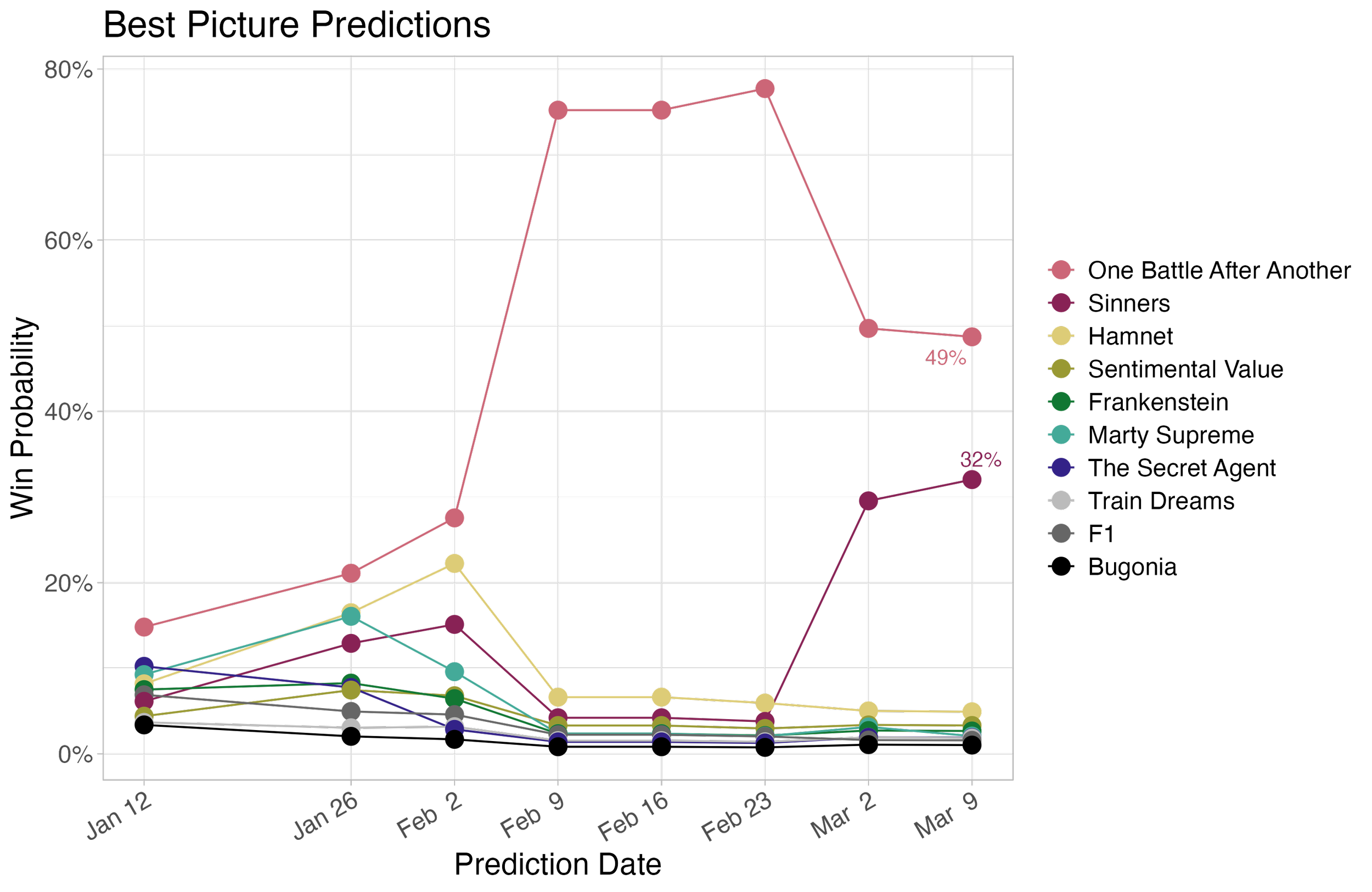
This is definitely the most interesting year that I’ve done this forecast. The SAG, ACE, and WGA awards tightened the race in the final weeks to now the prediction is pretty simple. There’s about a 50% chance that One Battle After Another wins. There’s about a 33% chance Sinners wins. Which leaves about a 17% chance that any of the other eight movies win Best Picture. Putting it another way: You have a side-sided die. If you roll a 1, 2, or 3, then OBAA wins. If you roll a 4 or 5, Sinners wins. If you roll a 6, then one of the other films wins. When you put it that way, things feel wide open.
And so, my official prediction would be for One Battle After Another to win—while noting that there is a whole lot of uncertainty going into this weekend. I do think, however, it feels like Sinners has been been picking up momentum, which is famously difficult to quantify. It is difficult, as it is hard to track news coverage over time since the news landscape has changed so much in 100 years. But I will be thinking about ways before next year to see how I could incorporate a “momentum” factor… if I even think that is a thing, given that voting for the Oscars ended before some of these other awards were announced.
March 2nd, 2026
This past week has been the most interesting of any of the three years that I’ve been working with this model. Last night, we saw Sinners take home the best ensemble and actor at the SAG awards. However, the ACE awards (editors) were also this past week, where Sinners also won in the drama category (while One Battle After Another won in the comedy category). Despite OBAA winning the PGA top prize this past week, we now see Sinners with a late surge. The last bit of signal we’ll get is the WGA awards, which Sinners could win (and OBAA, as well, since they are in different categories).
It is exciting to see a bit of a twist in the final stretch, as the last two years of running this model both provided consistent signal throughout the season as to who would win.
February 23rd, 2026
Once again, we had only one new data point: the BAFTAs. One Battle After Another took home the best film there, bringing its chances of winning Best Picture to 77%.
February 16th, 2026
Virtually no new awards were given out this week, so the win probabilities didn’t change: One Battle After Another still has about a 75% chance to win Best Picture.
February 9th, 2026
This year is interesting: The only change in the model from last week to this week was the reveal of who won the DGA. It was Paul Thomas Anderson, director of One Battle After Another. The drastic shift in probabilities shows you just how important this one award is. The film is also bolstered by the fact that it has been winning among critics’ organizations for months, but you really get a picture here for how crucial winning the DGA is. What will be interesting is if the big awards in the next few weeks, such as the Producers Guild Awards, differ.
And, as always, don’t count out the Academy doing something wild. It’s been a few years since a major surprise (CODA, at the 94th Oscars), and things that are a 1-in-4 chance (what the rest of the field has against One Battle After Another) happen all the time.
February 2nd, 2026
A shakeup happened in the last week among the top four: One Battle After Another (28%), Hamnet (22%), Sinners (15%), and Marty Supreme (10%). The big loser here was Marty Supreme, which was hurt by a number of nominations in a “comedy” category. And while One Battle After Another was also nominated among comedic categories, its plethora of nominations elsewhere insulated it from the same negative effect that felled Marty Supreme. There will only be one update for next week—the Directors Guild of America (DGA) award—but it is the single most important predictor of who wins the top award at the Oscars.
January 26, 2026
The first update here is limiting the field down to just the ten nominees. Although The Secret Agent did get nominated, it failed to get important down-ballot nominations that are strongly predictive of winning Best Picture (most notably, directing). Thus, it dropped from the #2 spot to the #6 spot. We see those nominated for directing at the top, with One Battle After Another still with a healthy lead. We’ll have to wait for award season to progress to see if it continues to pick up the requisite awards in the run-up to the Oscars to make it the presumptive favorite—or if we’ll see some surprises that make the race more interesting in the coming weeks.
January 12, 2026
I’m back with the Oscars Best Picture model, albeit a little late. I had a busy holiday season, but the story of December was surprising: The Secret Agent was the favorite, followed by One Battle After Another. This was largely due to The Secret Agent’s runtime, which is right in the sweet spot for Best Picture winners.
However, remember from the last two years that my model is assuming these movies have been nominated for Best Picture. The biggest barrier facing The Secret Agent is being nominated; it is a non-English language film. While the only non-English language film to win has been Parasite (2019), the nominations are rare enough that, given that the film has been nominated, having no English dialogue isn’t a barrier to winning. The DGA and PGA nominations make me think The Secret Agent won’t be nominated, however.
It also surprised me that One Battle After Another wasn’t favored more, given Paul Thomas Anderson is a generationally phenomenal writer-director, but none of his films have won Best Picture. Looking into the data, it looks like the “career award” is not much of a thing for Best Picture (like it seems to be for the acting and directing categories). Just the opposite: If a director has had a film nominated or won Best Picture before, it actually hurts their chances of winning in my model.
That was then, this is now, though. No more awards in my models will name nominees or winners before the Oscar nominations. Where do we stand going into the announcement?
One Battle After Another is the favorite, at about 15% chance of winning. Following it closely is The Secret Agent (10%), followed by Marty Supreme (9%), Hamnet (8%), Wicked: For Good (8%), and Frankenstein (8%).
You can read more about the details of the model from my post last year and the year before. The big change I’ve made here is calibrate the probabilities so that the model isn’t too sure of itself. I will see you on the other side of the Oscar nominations.